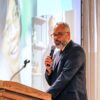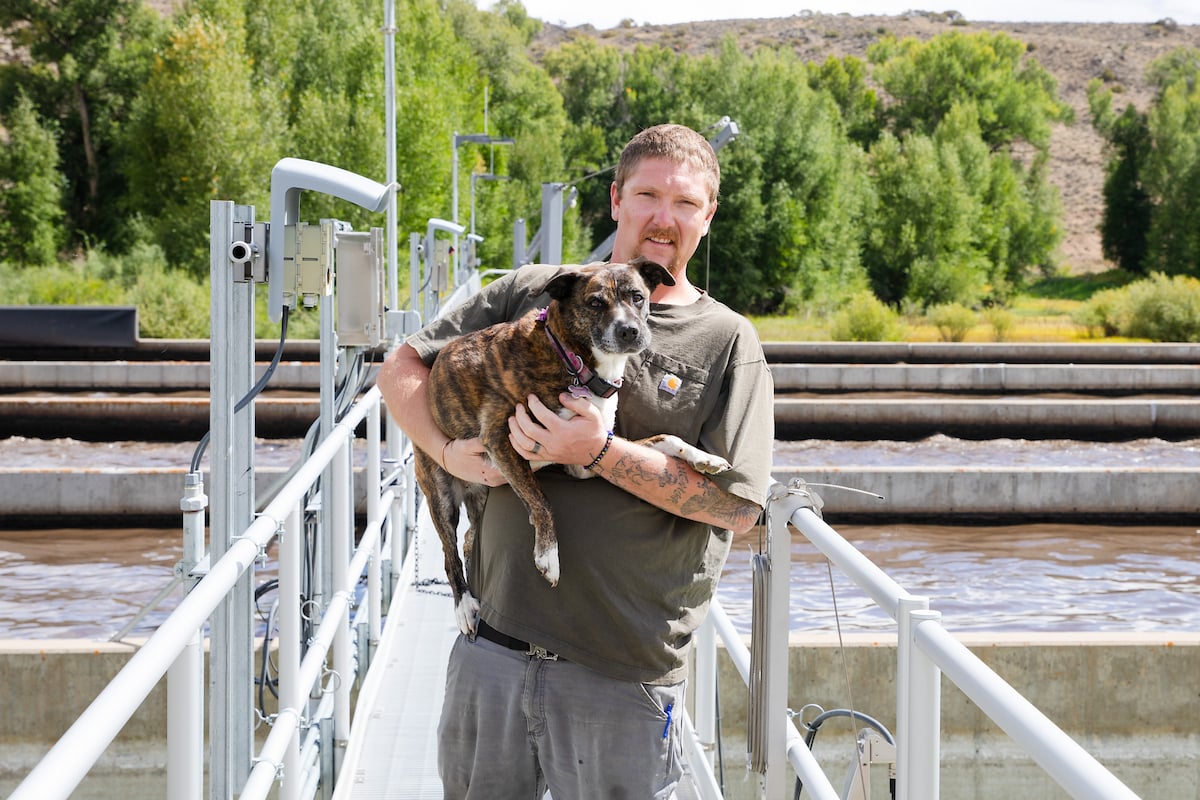
Don Getz might not be what you think of when you envision a frontline environmentalist. His sunglasses are safety glasses. His outerwear is a reflective vest. And his sandals are actually steel-toed boots. But of all the people in the Gunnison Valley concerning themselves with the state of our water, he might be the one watching it most closely.
When Getz arrived at the Gunnison Wastewater Treatment Plant in 2017, it wasn’t where he expected his career to take him. After high school in Grand Junction, he moved to Steamboat for college, but mostly to ski. That put him in contact with public land, which made a career in one of the land management agencies seem like an attractive option.
But the skiing got in the way of the schooling, and he started to bounce around before landing in Glenwood Springs, where he earned his associate’s degree in biology at Colorado Mountain College. “Honestly, straight out of high school, I was just told that I gotta get the paper,” Getz said of his quest for a college degree.
But it didn’t feel like his degree would take him where he wanted to go, so he started to think about pursuing a bachelor’s degree in environmental science. By the time he arrived at Western with his wife, Kristen, in 2015, Getz had spent much of the past five years looking for a career where he could contribute to the landscapes he cared about. But somehow, wastewater never entered the picture.
Then he needed an internship to graduate and followed a friend to the lab at the Gunnison Wastewater Treatment Plant, just feet from the bank of the Gunnison River west of town, where he worked running nutrient tests. No place, perhaps, outside the landfill made the human impact on the environment more apparent.
Downstream, the Gunnison River becomes the second-largest tributary of the Colorado River, feeding water to crops and faucets across the desert Southwest. Each time that water passes through soil, runs off a field, or moves through a treatment plant, it can pick up salts, nutrients, and other contaminants. And because those compounds accumulate as the river moves downstream, what leaves Gunnison matters far beyond the valley.
Beyond the drain
At first, Getz was primarily in the lab running nutrient and compliance tests. But when things slowed down, he started following longtime operator Clay Wilson out into the plant to fix equipment and see just how much was going on where the plumbing ends.
“It was kind of along the lines of, milk comes from the store, water comes from the faucet,” Getz said. “I never knew the scope of how big this facility actually is.”
More than a million gallons of wastewater can move through the plant in a day, enough to classify it as a major facility and bring with it additional staffing and regulatory requirements. Yet just four crew members are responsible for keeping the plant running, so specialization only goes so far.
On any given day, Getz splits his time almost evenly between the office and the plant, taking him from a computer to a loader, from writing state and federal permit applications to troubleshooting equipment. The plant operates a regional compliance lab, monitors the quality of its discharge, as well as the river above and below the facility, and maintains an array of pumps, probes, and other equipment required to keep the process running.
The process itself is part biology, part chemistry, and part mechanics, employing microorganisms that consume organic material in the water before they become part of the solids removed from the treatment process. The solids are then dewatered and mixed with wood chips before spending about a year composting on site. What’s left is screened and sold back to the community as an ultra-rich soil supplement known as Gunni Gold, turning two waste streams into something people can use.
For Getz, the work brought together two parts of his life that hadn’t seemed particularly connected. His father was a master plumber, and Getz grew up helping him fix things. He worked on cars and built rock crawlers. At Western, meanwhile, he was studying environmental science and water, imagining a career spent protecting the landscapes he cared about.
At the treatment plant, he could do both. “The internship is how I discovered that I have an aptitude for this field because I like working with my hands,” he said.
Finding his place
After finishing at Western, Getz took a job as a wastewater operator for the Town of Crested Butte. But 18 months later, an opening brought him back to the Gunnison plant, where he worked his way from operator to lab technician to chief operator and, just seven years after he started, superintendent.
“I think that the internship is pretty important because seven years later, I’m here,” he said. “And going through school, I never thought about being in drinking water or wastewater treatment.”
At just 35, Getz is young for a position that traditionally might come after 20 or 30 years in the field. But wastewater is going through something of a generational shift. Getz can see it at conferences, where attendees tend to cluster at opposite ends of the age spectrum: young operators entering the profession and longtime operators preparing to leave it. At the Gunnison plant, two members of its four-person crew worked there for more than 30 years before retiring.
“There’s no shortage of work to be done,” Getz said.
For students who enter environmental science and imagine a career with the Forest Service or the Bureau of Land Management, Getz sees an opportunity hiding in plain sight. The infrastructure most people rarely think about needs scientists and regulators, but it also needs people who know how to troubleshoot a pump, calibrate a probe, turn a wrench, and understand what all of it means for the river.
And in Gunnison, that connection is particularly hard to miss.
Every month, the plant samples the Gunnison River above and below the facility and monitors its own discharge to determine the effect on nutrient levels in the river. Even during the low flows of winter, Getz said, treated wastewater accounts for only about 4 percent of the river’s flow, and the plant’s impact is negligible.
Getz remembers studying environmental disasters in school and feeling overwhelmed by their scale. But working in wastewater taught him to think about environmental stewardship in more manageable terms.
“You just got to focus on what you can physically affect and not bite off more than you can chew,” he said. “Even if you look locally, there’s always something that you can do.”
Author Credit: Seth Mensing