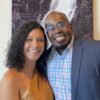
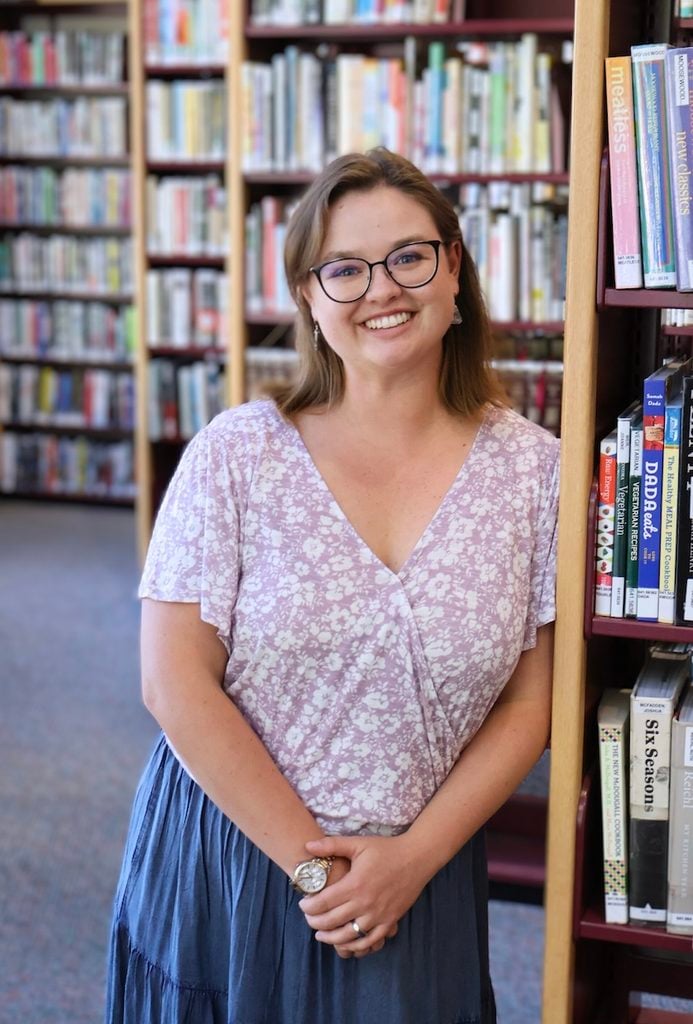
Taylor Worsham’s journey from Western to librarianship was far from linear. After graduating in August 2016 with a degree in Politics and Government, Taylor started her career in Western’s Marketing & Communications Department before deliberately pivoting toward work that felt more meaningful and community-focused.
Advocating for herself and always looking for the next opportunity, Taylor worked her way up from volunteering to becoming a full-time librarian while earning her Master’s in Library Science at the same time.
As a librarian, Taylor has built her career around reimagining what a library can be and finding new ways for libraries to serve the communities around them. In Gunnison, she helped develop programming and community outreach efforts and played a role in bringing the new Gunnison Library to life. She then took those ideas to Paso Robles, California, where she served as the city’s first Outreach Services Librarian and helped create a bookmobile program.
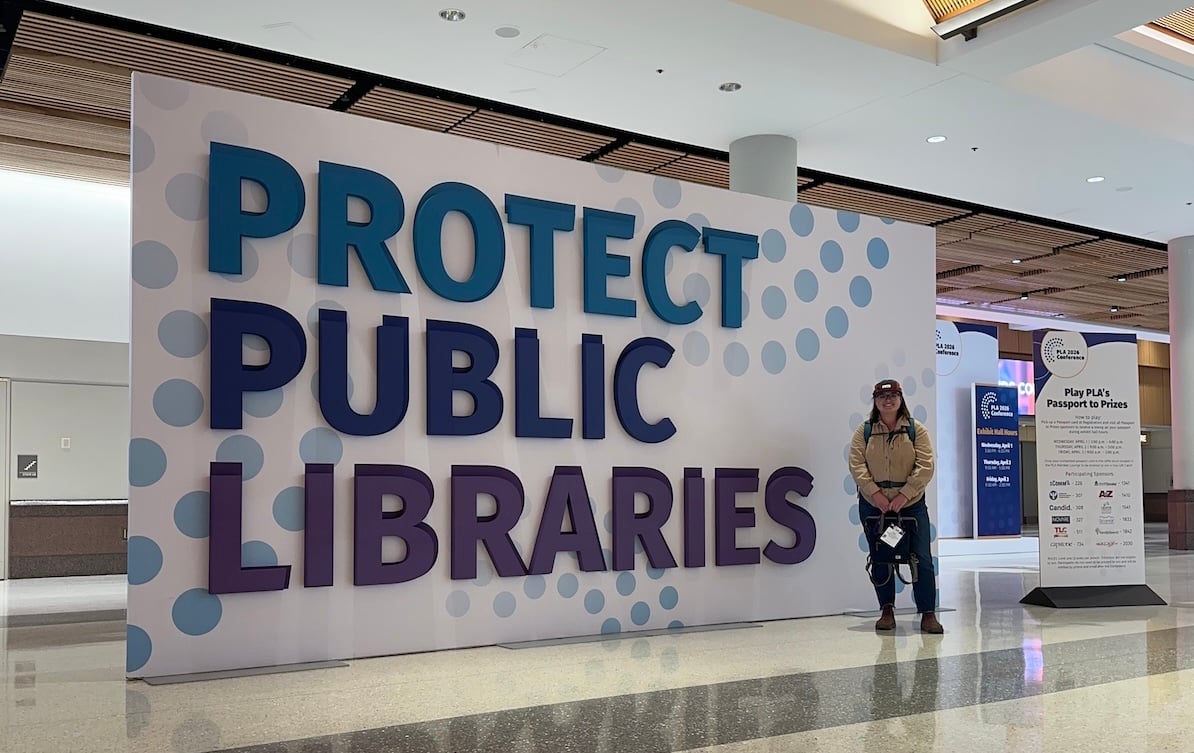
Now, Taylor is back in Colorado, working at the Ruby Sisson Library in Pagosa Springs, where she is helping guide an expansion and renovation project that will add up to 40% more community gathering space.
While her career has taken her from Western to Gunnison, California and back to Colorado, the thread connecting it all is simple: Taylor wants to help people.
For Taylor, libraries are uniquely positioned to do just that. “Libraries are the most democratic institutions in society,” she says. “Libraries are free and open to everyone, providing spaces to gather and access to and sharing of knowledge. A library is a crucial third place outside of work and home.”
Taylor’s career is a good example of what it means to be a Mountaineer. She didn’t follow a straight line, but she stayed curious, advocated for herself and wasn’t afraid to take a chance on something new. We asked Taylor to reflect on the path that brought her here, the people and experiences that helped shape it, and what she hopes to do next.
How did you discover Western?
I discovered Western when I was on a backpacking trip in northern New Mexico, the summer before my senior year. There was a gal, Anna Boyle, who had just finished her freshman year at Western, and she would not stop talking about it. She loved Western so much.
I was 17, and another girl on the trek, Amy Albritton, was 17, so we were both looking at colleges. I thought my options were going to be limited to in-state, but when Anna told us about Western, I was like, oh my gosh, it would be such a dream to go to a school in Colorado.
I was fortunate enough to get scholarships to make that dream a reality. Amy and I were roommates and friends with Anna all through college. It could not have worked out better.
What degree did you pursue, and how has it shaped your career?
I have a Bachelor of Arts in Politics and Government, with an emphasis in Global Studies, and a minor in English.
The biggest reason why I wanted to study politics and government was my way of understanding the world and the systems that society relies on to function. Along the way, I started to realize just how much support there is in our local government and that you can have the most impact by serving your community locally.
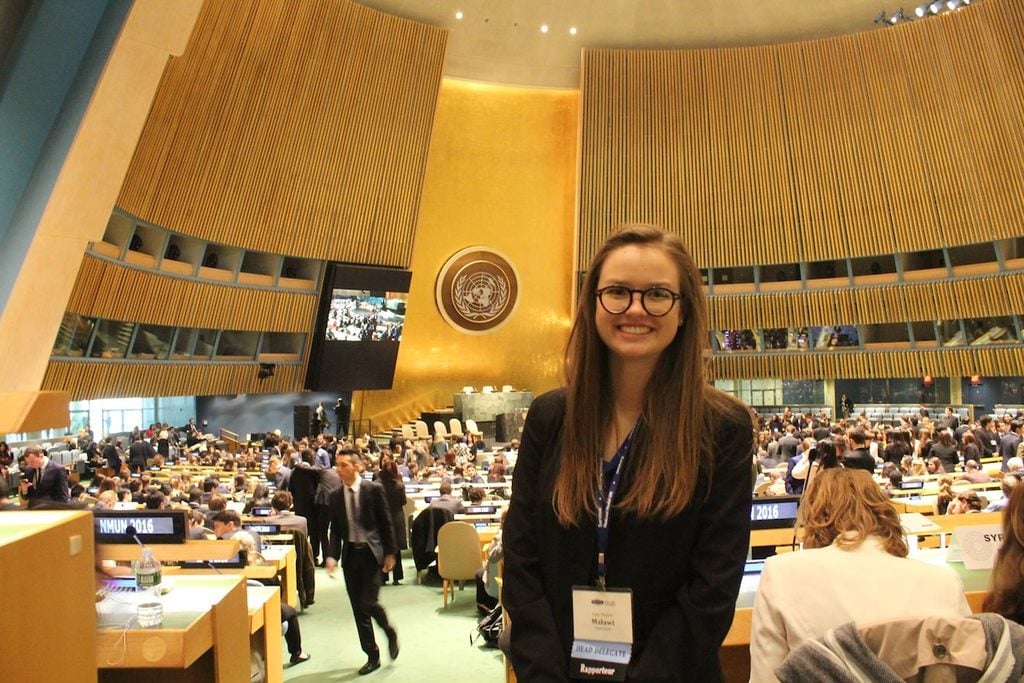
I actually, with another student, started the Model United Nations team at Western that fall in 2013 because I had competed with a team in community college before I moved to Western. I just thought that Western should have a team and we should go to New York City and engage with these students from all over the world. It was such a good way to gain exposure to other cultures and learn from them.
I studied everything that I could while I was at Western because it was a small school, and I loved the liberal arts aspect of the degree because it allowed me to survey different subjects, but with the ultimate goal of finding a career that I could help people.
Was there a professor, mentor or experience at Western that had a lasting impact on your career or life?
Definitely. I owe a lot of my success to Dr. Maria Struble. She was the professor who took a chance to start the Model United Nations team with us, and she gave so much of herself and was so much more than a professor to us.
When you think back on your time at Western, what’s the first memory that comes to mind?
I think it has to be all the hikes and the camping trips. I was also on the Western Mountain Rescue team for my first two years in college, and they took me to so many fun places.
One of my favorite early memories was, freshman year, we decided to go hiking on Homecoming weekend instead of going to the football game and partaking in the festivities on campus. I don’t know why we thought that was a good way to celebrate Homecoming. It was pretty late in the season. There had definitely been some snow already.
So we drove out to Lake City to climb Sunshine Peak via Redcloud Peak. After a freezing night in my friend’s Subaru we tried for the peak and we got pretty high, like maybe to the saddle. And we’re just starting to post-hole in knee-deep snow, and just an absolute miserable suckfest.
But I often had these times where it’s like, “Oh my gosh, is this my life? Is this really happening?”
Western and the experiences that I had there, especially in the mountains, were so much different than my childhood growing up, and I could have only dreamed of climbing a 14er with my friends in the snow.
There are so many lessons that you learn in the classroom at Western. It is such a personalized approach to education. But the environment and the mountains and the community of recreators, even the professors, everyone loves the outdoors there, that added to my experience so much.
What led you from Western into librarianship?
After I graduated in 2016, I was at Western’s Marketing Communications Department because I wasn’t ready to leave the valley. It was a solid opportunity, and it was a good first professional role. I liked the people that I worked for and I think they invested in my early career.
A couple years in, I realized that I wanted to find a profession that was really fulfilling to me, that had deeper values that drove it, and something that I interfaced with more of the greater public and was outside of the campus community.
So I reached out to Drew Brookhart, who’s still the Executive Director for Gunnison County Libraries, and said, “Hey, look, I’m plotting my next steps. I have this marketing experience. I could come and help the library. I’d love to volunteer and help with your social media.” Luckily, Drew gave me a chance. Eventually, a full-time position opened up and I applied.
I’ve worked my way up from a library tech, which is kind of like an intro position. I was at Gunnison and the Crested Butte branches, but then quickly I became the marketing and adult programming coordinator, so I started to take over both of those departments, which weren’t very well established at all, and there was never a dedicated person for either of those.
Of the projects you’ve worked on, which one still feels most surreal when you think back on it?
I think in all of my positions, there has been a defining moment. It felt so surreal to let people in the doors of the Gunnison Library because not long before that it had just been an empty field and to see that through from campaign to design to construction to opening, and then strategic planning to be able to know what to do with this new building that the community wanted—that was probably the most surreal.
Is there a moment in your career that best captures why you do what you do?
Throughout my career, I’ve had individual tech appointments with people, helping them solve problems they’re experiencing with their phones or tablets. I really like that aspect of the work, helping people with very tangible problems. So I started that back up in Pagosa, and every Thursday I have Tech Time.
A couple came to my Tech Time recently and told me their phones had been stolen while they were in Costa Rica. They had been dealing with issues with their bank and thought someone was hacking their accounts. They had been trying to resolve it for about six months, calling the banks, police, and even the consulate in Costa Rica.
We sat down together and looked at their Google accounts. We discovered someone was still actively logged into their phone in Costa Rica and had created a passkey, so even though they had changed their passwords, the person still had access.
I said, “Oh my god, someone is logged into your account right now in Costa Rica. Let’s kick them off.”
We signed them out of all their devices, and I told them to go home and change every password they had. They came back a couple weeks later and had resolved everything. It was just wild that we were able to figure that out sitting together at the public library.
Looking back, what’s the most valuable lesson you learned at Western?
I have been thinking about it more this year because it’s 2026, and that’s 10 years from when I graduated and the life I’ve been able to build since then.
Maybe the greatest lesson that I learned was that we all have our own stories and we have way different backgrounds. I met people at Western from all over, and that was a great experience for me to spend time with them in class, listening to their perspectives, or just in other places on campus or in town.
Western encouraged me to dig deeper, to get to know people and why they are the way that they are. Which helps me right now to just approach people as they are.
If you could give one piece of advice to today’s Western students, what would it be?
My advice would be to make the most of your limited time there. Visit these places while you can.
There’s an opportunity at Western to try things and go places you ordinarily wouldn’t. So, just go for it! I think Gunnison is a pretty safe place to experiment with who you are. You may surprise yourself with the experiences that you have that’ll impact the rest of your life.
What is something that people might be surprised to learn about you?
In 2011, when I was 17, I gave a TEDx talk.
At that time, I was homeschooled. I left public high school in my sophomore year. I just felt like high school wasn’t serving me, and I didn’t know what to do next because I was so overwhelmed with all the things I was committed to. My first year of high school, I was on the varsity swim team, I was in the marching band, and I was doing AP classes. I just wanted to take a step back and pursue my own interests.
I took that opportunity to talk about how, unschooling by homeschooling, I was able to not sit at a desk for eight hours every day but actually figure out what I wanted to do with the rest of my life. I talked about how if you can choose to learn the way that you want, then you can find success, and you should feel empowered to do that.
What does receiving the Pathfinder Young Alumni Award mean to you?
I was really, really surprised to receive it because there are so many phenomenal alumni.
I was really glad to be selected for the award as a librarian and a public servant. I’m proud of my story, and I’ve had so many opportunities, and I got my start in the valley. My professors and community members really nurtured me, and I wouldn’t be where I am without them.
It means a lot to be recognized, to feel seen, and to know that the journey I’ve taken so far is an admirable one.
And maybe there’s a student out there who reads my story and is inspired to be the next generation of librarians, or someone who didn’t grow up in the mountains but thinks it’s possible to go out and embrace a new lifestyle and to risk it all to come to little Gunnison and then get this amazing experience and go on to build a life that they love.
Author Credit: Seth Mensing